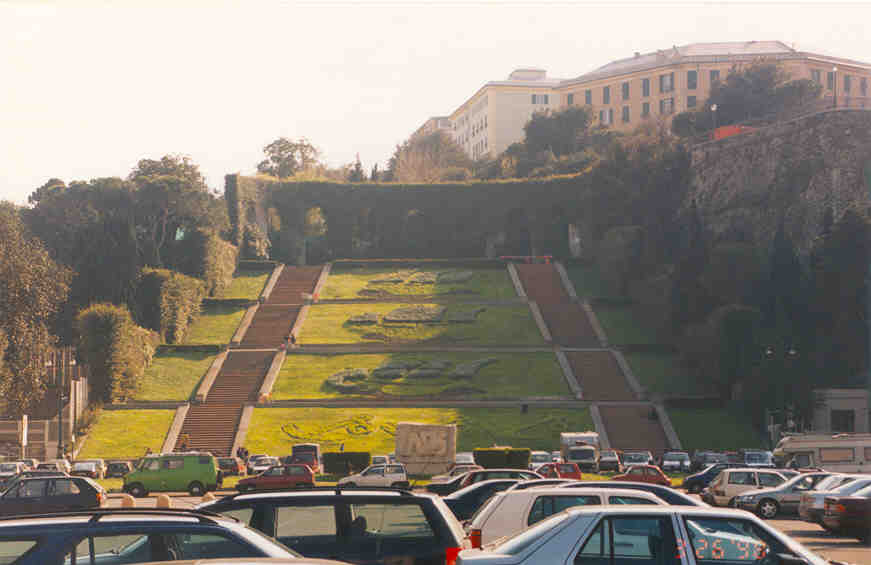
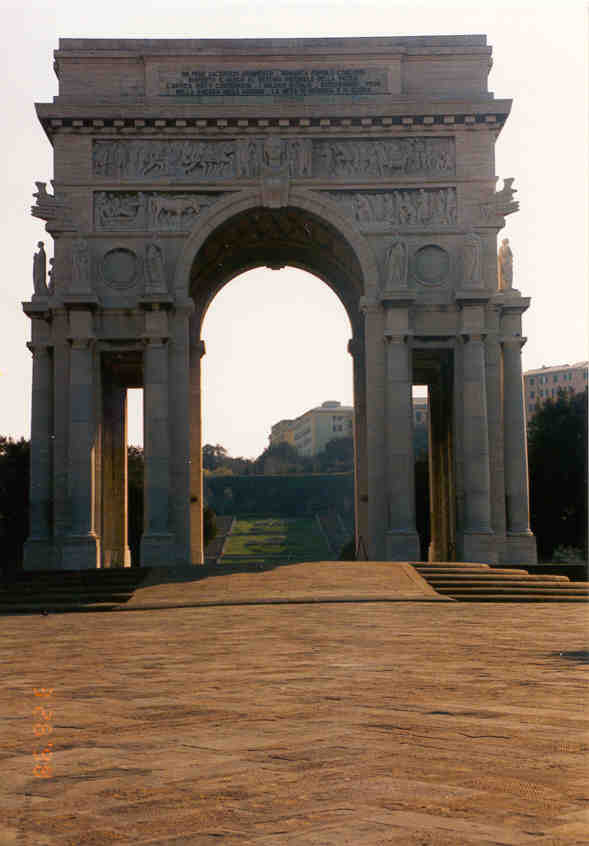
Genoa (Genova) (LIGURIA) The chief city in the region lies in the innermost part of the gulf to which it gives its name,
and stretches for c. 25 km. along the coast and c. 15 km. inland up the Polcevera and
Bisagno river valleys. Originally sited on the Sarzana hill, the city underwent subsequent
phases of expansion (in the 12th-14th centuries and 16th-17th centuries) within the city
walls, but not until the 19th century did Genoa began to grow to considerable proportions
by absorbing an initial group of suburban villages; this trend reached its peak in the first
thirty years of this century, giving origin to the conurbation.
Founded by the Ligurians, it became an important Roman municipium before passing,
after the fall of the Western Empire, into the hands of the Byzantines, later succeeded by
the Lombards and Franks. In the Middle Ages it was ruled by the bishop-counts, then
became a free municipality (12th century) and a formidable naval power, engaged in
fierce struggles first with Pisa, and then Venice, for supremacy in Mediterranean trade.
After a period of decline at the turn of the sixteenth century and an object of contention by
France, the Duchy of Milan and Spain, it again prospered under the command of Andrea
Doria, regaining in 1528 an independence which was to last, with varying degrees of
fortune, until 1797, the year of the declaration of the Napoleonic Ligurian Republic. In
1815 it was annexed, with the whole region, to the Kingdom of Sardinia, sharing its
history.
Monuments: the Cathedral (11th-15th century), Santa
Maria di Castello (11th-12th century), San Donato (Romanesque, 12th-13th century), San
Siro (16th-17th century), San Matteo (13th century), Santa Maria Assunta Carignano (16th
century). Of the civil buildings: Palazzo San Giorgio (Gothic-Renaissance), Palazzo
Municipale (16th century), Palazzo Rosso (17th century), Palazzo Spinola (16th-18th
century), Case dei Doria (13th-15th century) and many others, mostly Baroque, which
gave the city its deserved title `Superba'.
The city's economy is based on the port, the largest in Italy (covering 45 sq km. of water),
which, however, is finding difficulty in coping with the competition of the North European
ports especially in container traffic. Closely linked to port activities are insurance, finance
and transportation. The industrial sector present concerns the transformation of transit
freight, chemicals, petrochemicals, steel, the metallurgical industry food and shipyards. In
the summer months there is considerable tourist traffic.
Events: Salone Nautico Internazionale (international boat show, autumn), international
exhibition of tourist and hotel facilities (Tecnhotel), wine and spirits exhibition (Bibe) in
October November, Euroflora, Premio di Violino `Niccol Paganini' (violin award), the
`Repubbliche Marinare' regatta (every four years), international sailing craft regattas,
`Palio remiero dei sestieri' (29th June), Columbus celebrations, Fiera di Sant'Agata.
Famous People: Christopher Columbus (explorer and traveller, 1451-1506), Niccoló
Paganini (musician, 1782-1840), Giuseppe Mazzini (politician, 1805-1872), Bernardo
Strozzi (artist, 1581-1644), Domenico Piola (artist, 1628-1703), Benedetto XI (Pope,
1854-1922), Gilberto Govi (actor, 1885-1966), Eugenio Montale (poet 1896-1981).
Cultural and Research Institutions: University, various cultural institutes (Istituto
Colombiano, Istituto Mazziniano), Museo Archeologico Ligure (archeological museum),
Galleria di Palazzo Rosso, Galleria di Palazzo Spinola (paintings by Antonello da
Messina, Guido Reni, Van Dyck, Strozzi, De Ferrari), Galleria di Palazzo Bianco (all art
galleries), Museo di Storia Naturale (Natural history museum), Museo dell'Istituto
Mazziniano (Risorgimento memorabilia), Museo Navale (naval museum), Galleria d'Arte
Moderna (modern art gallery), Museo Luxoro, Biblioteca del Conservatorio Paganini
(Paganini Conservatory library), Istituto Italiano della Saldatura (Italian Institute of
Welding), Ansaldo Ricerche (research centre).
In the Province: Numerous beach resorts such as Chiavari, Rapallo, Portofino (nature
park and museum), Santa Margherita Ligure, Camogli (maritime museum, archeological
museum), Sestri Levante (shipyards), Nervi (opera and ballet performances), San
Fruttuoso (abbey, Cristo degli Abissi-underwater statue), Pegli and Arenzano.