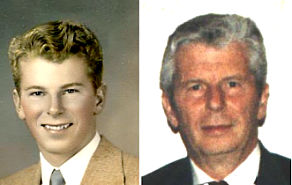
Newel Kimball and Korea - Part One
FIRST TIME IN KOREA
I joined the Army Enlisted Reserve in Utah while still a Senior in high school, and went active in November of that year (1953) to avoid starvation. As my mother and father were lost to me when I was three, I was adopted and raised by my maternal grandfather and his second wife (poor lady!). She had died while I was a junior in high school, and my old Dad had become ill the next year, requiring him to go live with his daughter in Idaho, so I was alone in Farmington. I had worked at Lagoon all through high school years, summer was over, with no work, and no where to go. I knew that there was a good education awaiting me in the Army, so I went active. What an education!
During my final stateside assignment at Fort Hood, Texas, I had just won a series of musical contests, mostly with "Granada" and "Maleguena". The prize was an appearance on the nationally televised Arlene Francis Soldier Show in New York City. Sgt. Kline, First Sergeant of my engineering company said to me, "Kimball, You have been here for five weeks, and I haven't had one good week of work out of you. If you go to New York-- when you return, I will place orders for Korea into your guitar-pickin' hand!" The reason why I hadn't done any work was due to the company's policy of giving a three-day pass to the sharpest soldier (supernumerary) on guard duty. I was taking money from other guys to pull their guard, and then with the three-day pass and the money I could spend a cheap three days in Temple (Texas) reading the Book of Mormon at the public library (I had been told by a minister in Kansas City that Joseph Smith was an epileptic and that the Book of Mormon was a pack of lies, and I promised him that I would read it and get back to him, but I lost his address). Besides the weekend passes that covered Saturday and Sunday for each of the five weeks I had been at Fort Hood, I had received four three-day passes for guard duty as well. So, I guess I could see Kline's point of view.
So, I went to New York for a week and had a really good time being on TV. The down side of the trip was having my wonderful old guitar stolen at the Houston Airport-- so I couldn't play "Malaguena". The TV people tried to provide a good guitar to replace mine, but the replacement that came from the Arthur Godfrey musical instrument supply room was really bad, so I played and sang "Cool Water" to Arlene Francis instead. Anyway, when I got back to Fort Hood, Sgt Kline handed me my orders for Korea, and said, "Kimball-- I told you what I was going to do!".
When the 1000 of us got off the ship, we were transported standing vertical in deuce-and half trucks along some very rough roads to the debarkation camp in Pusan for an orientation session. The speaker asked how we liked the rows of whore houses along the way, and then stated that there were about 50 Korean women that were going to board the same ship we just got off for the trip to the U.S. with their GI husbands. No one could believe it, so we hooted and booed the guy. Little did we know.
After processing for a day or two, a bunch of us were sent to Seoul. My assignment was to an engineering outfit attached to the Military Armistice Commission of the United Nations Command at Munsan-ni (UNCMAC) The place was the base camp for seven Generals who had the task of negotiating the peace agreements with the North Koreans and Chinese at Panmunjon. After getting off the train in the morning and going through some further processing, around 4:00 in the afternoon I was herded into the front seat of a quarter-ton truck going to Munsan-ni, about 30 miles away.
I was struck by the scenery as the small army truck made its way rather slowly along the winding dusty road. Everything was in ruin. The rice fields were full of land mines. The few houses along the road were made of mud, but they were obviously new, as the thatched roofs were a light tan instead of the weathered dark brown of older buildings. The windows were covered with oil-paper, as glass was either unavailable or too expensive. As twilight approached, dull yellow candlelight began to appear through the paper windows. In spite of the foreign landscape, a very strange feeling came upon me. It felt as if I were returning to something I had somehow forgotten- a very familiar place-- like returning home after having been away for years!
That part of the country side that had so far been reclaimed from mine fields, for farming was beautiful indeed. I never tired of taking pictures of their planting and harvest activities. I loved to get a jeep and go to Seoul to haunt the Marketplace, a strange exotic jungle with every conceivable product sold in hundreds of shops under re-claimed canvas and corrugated tin made of pop cans. I watched a shoemaker sew a pair of shoes. He seemed amused that I would be interested. I bought a pair of rabbit-skin gloves, and I watched and waited while the woman hand-stitched a pair for me
nothing the army provided was as warm (what ever happened to those gloves?). I watched men engrave lovely oriental designs on pots and dishes made from spent brass Howitzer shells, and even bought a set of the engraving tools (which I still have). I ate their wonderful roasted chestnuts and sesame seed candy. The music they played was a haunting noise to me then, but it was also familiar. Then back in the Jeep and off to Munsan again. The trips to the Seoul Market were wonderful, and I went as often as possible.
A fellow soldier (can't remember his name now) asked me if I wanted to go to a mission home with him. We went to a rather nice brick compound in Seoul that had its tile roof even after the intense shelling of the war. I was introduced to a very old (85?) American woman dressed in Korean clothing. She was a member of the Underwood family. I didn't know it then, but the Presbyterian "typewriter" Underwoods were the key to the massive conversion of the Koreans to Christianity early in the century (more later). She didn't seem too interested in me, but I took her picture, which I still have. It would be nice to know who she really was and what she had accomplished during her long lifetime in Korea.
After I first arrived at Munsan, I linked up with the Mormon boys on the base and around the area. There were several LDS chaplains still in Korea even though the war was over, but their time was short. Mark Money and Spencer Palmer are two whose names I remember. Fine, strong men trying to help their flock ward off the evil of the place (I heard from someone at the top that 85% of the men at UNCMAC lived off the base with Korean women). But before long the chaplains were gone, and Rodney Fye, an army warrant officer in the CIC or CID, was placed in charge of the LDS servicemen in the area. I loved the LDS fellows. There was Paul Winn who, like Rodney, had worked for Howard Hughes in a previous life, but now was the UNCMAC Commanding General's private secretary (Paul could type 150 words a minute on a manual typewriter!). Drew Vanwagoner from Layton- Hal Wilcox from Clearfield-- Hebgen from Ogden- and many, many others whose names are gone now.
Rodney Fye called me to start a newspaper for the LDS boys stationed throughout the Far East. My normal duties as generator operator for the camp gave me the time to collect and type Mormon material, print it off on the camp mimeograph machine and send it to the men stationed in Korea, China, Japan, Okinawa and the Philippines. I spent a lot of time reading Mormon literature, and thinking about religion in particular. Along about August of 1955, I had the job of recording and transcribing all the talks of the grand apostle, Joseph Fielding Smith, who had come to dedicate Korea for the preaching of the Gospel. And, there were many others who also spoke at that same time-- President Robertson of the Japanese Mission, Dr, Kim Ho Jik-- President of the 60 or 70 Korean Saints that had been converted by the servicemen in Korea, Grant Heaton --soon to be called as the President of the Southern Far East Mission, and many others. I recorded their talks on tape and transcribed them onto the LDS newspaper. It was a profound time. I type with the first two fingers and thumb of each hand at about 50 words per minute. A person speaks normally at about 90-120 words a minute, which means that if the words are on tape, you have to listen for a bit, then type, then turn the tape back a ways and listen some more, then type some more. Joseph Fielding's words were engraved on my mind, along with the others. The newspaper of this event was very large, took quite a while to finish, and was the last significant thing I did before leaving Korea in the Army.
At the serviceman's conference held at Munsan with Joseph Fielding Smith, I asked President Robertson how long it would be before missionaries would be sent to Korea. He told me that it would be at least ten years before the land would be ready to receive missionaries- it was too torn up and devastated. I knew that instant that I would be returning to Korea in a very short while. As I left Munsan along in September of 1955, I told many of my service friends and several Koreans that I would see them again soon. The GI's merely laughed at me, for how would anyone want to come back to Korea, let along get back? The question seemed reasonable, but I still said I would see them again. The Koreans just seemed puzzled.
I came home and enrolled At Weber College for the spring quarter. I took a typing class (and some others), in which I learned touch typing. Before the class was over I had attained the speed of 50 words per minute. And with the other things that went on, I whiled away the winter months of 1956.
Newel Kimball and Korea - Part Two
THE CALL
I Left the Army in December of 1955, and was about to start winter quarter at Weber College under the GI Bill. On Sunday, January 7, 1956, (my 21st birthday), I had come down from Ogden to Farmington to locate old friends at church. There were no friends around, but Max Muir, my Scout Master of previous years ( I had earned the 2nd class badge) came out of the Bishop's office and said that Bishop Staynor wanted to see me. I thought, "He wants to find out about what I did in the Army." Bishop Staynor said he was glad to see me back from the army, and he did chat awhile about what I had been doing for the past two years, and then asked me if I wanted to go on a mission. It really seemed an odd question at the time, but after the surprise, I said that I would-- if I could go back to Korea. He said where I went would be up to the presiding authorities. He interviewed me about my past sins and then sent me on to see Stake President Blood in Kaysville. President Blood chatted awhile about my time in the army and interviewed me about my past sins. He then asked if I wanted to go on a mission. I said that I would and told him I wanted to go to Korea. He said that the decision would be up the authorities. He then arranged for a meeting with a Church authority. The meeting was to be held in the old museum building on Temple Square in Salt Lake. As it turned out, the interview was with Marion "Duffy" D. Hanks. He chatted awhile about what I had been doing with my life and he wanted to know about my past sins, which I told him. He said, "Where would you like to go on your mission if you were called?" (I think they asked that of everyone, just to reverse the foolishness that is in us all- as everyone of course wants to go to England or Austria or Switzerland--some nice place) I told him that I wanted to go to Korea. He answered instantly, "Brother Kimball, the Church does not have a mission in Korea!" I replied that I was aware of the fact there was no mission in Korea, but that there would be one soon, so send me someplace close, like Japan, so that when the missionaries were finally called into Korea, I could then be transferred there. Elder Hanks wrote something on a piece of paper and slipped it into his desk drawer. He said that I would be getting a reply from the Church in due time. I went back to Weber College. In due time, the letter from the Church came- Northern Far East Mission (Japan)!
I went to Salt Lake for April Conference, and while at Temple Square just outside the Tabernacle, I chanced upon Rodney Fye and one other army friend I had been with in Korea. Rodney had just received a letter from Sister Kim Do Pil stating that Paul Andrus was the new Mission President in Japan, and that he had assigned two missionaries to arrive in Korea in May. I knew at that instant why I had said the things I had said!
I finished the rest of the winter quarter at Weber College and prepared to go to Japan. I had studied Japanese while I had been in the army in Korea, but with no success, "Japanese in Thirty Hours" was the book. The book made no sense whatsoever. I tried again to get something out of it-nothing. I concluded all my affairs as best I could. I was alone, except for my life-long friend and room mate Heber Jentzsch (now head of International Scientology), and a few others at the college, so I was ready to go. The wonderful Farmington ward people had pledged the $50.00 a month that I would need for the three years, so along with some needed traveling money that I had and with donations from my farewell, I was off on the train to San Francisco.
End Part Two
Newel Kimball and Korea. - Part Three
FROM SALT LAKE TO TOKY0
Strange how I can only remember a few of the names of the people with whom I traveled by ship to Tokyo. I well remember Elder Ronald Hills. Karl Fletcher must have been in the group as we left the Salt Lake MTC at the same time. There was an Elder Paul Morris and a Sister Olsen in the group, with eight in all, I believe. Records could be found to show who they all were, as it was a most interesting collection of traveling companions. Was Dean Anderson in the same group? I can't remember.
While in San Francisco, we went to a Chinese restaurant. We were all talking rather animatedly. Elder Morris picked up his napkin to wipe his face, with his tie directly on top of the napkin. The tie did not fare well, and we didn't either, what with all the merry laughter about the soiling of his tie.
Rodney Fye was in the city at the time, and came to the hotel to take me to a District conference somewhere in the area. Elder LeGrande Richards was the speaker. He told of a meeting where he was the speaker at a gathering of prominent bankers. They told him that they didn't want to hear about banking-they wanted to hear about the Mormons!. So he talked for 15 minutes about the Mormons, and then tried to steer over into banking. They emphatically told him to just go on about the Mormons and forget about banking. So he spoke for better than an hour, when they finally let him go. He went up to his room in the same hotel, and was kneeling down thanking his Heavenly Father for the opportunity to speak frankly to such an influential group, when there was a load banging on his door. He got up to answer, and there two of the bankers had followed him up and were standing there. One had a big cigar in his fist. He banged on the door frame and said, "By Hell... I'm gonna be a Mormon! Brother LeGrande brought the house down. He was the last speaker and when he closed, he announced the closing song and announced the name of a person for the closing prayer. After the closing song, a young man came to the pulpit. He stood there the longest time. Finally Brother Richards came up to him, and asked him why he didn't pray. The young man said, in a voice loud enough to hear, "I don't know how to pray... I'm not a Mormon!" LeGrande said, AThat's all right, son, I'll just tell you the words, and you repeat >em, and God will hear you just fine! And so they did.
We sailed on the President Wilson ship for Tokyo. One week into the trip we docked at Honolulu, and I was given the quandary of what to do about the traditional Hawaiian greeting of the lei around the neck and the kiss by a beautiful girl. I was sure I was being dragged into the pits of hell, but it was over in an instant. I then saw that the lei and kiss were given everyone, so I didn't feel so bad about being kissed by a beautiful young woman. We were met by the Fongs, who took us to their place for a feast of food. I never forgot the lesson of how to skin a ripe pineapple with a table knife, or how to drop a coconut to break it exactly in half. They then drove us across the mountain to the temple for a visit there. What a lovely place!
As we embarked that night, a beautiful Tahitian girl was flipping feathers off of a string belt she wore as she danced on a platform at deck level within six feet of Elder Hills and I. And so on to Tokyo! Such memories!
I had not been able to take much more than $50 for the trip, and somewhere past Hawaii, I ran right out of money. I had no idea what to do. Our group went virtually everywhere together when we were out of our staterooms. The two-week trip was in wonderful weather, and there were always lots of people on deck in the lounge chairs. One of those promenade days, an old lady beckoned to me to step over and talk. The rest of the group went on, as we were always having conversations with other passengers. I sat down in front of her, and she said, "You are out of money aren't you?"
One of the defining moments of my life occurred when Mrs. Hawkins spoke in frank terms about her own life. Early in marriage, her husband had abandoned her with two little girls. She wondered how she was ever going to care for herself and her children. She fell on her knees and promised God that she would serve Him the rest of her life if He would but show her what to do. The thought immediately come into her mind to open a dress shop (she was a skilled seamstress). She said she never wanted from that day forward. "Have you seen the big neon sign >JESUS SAVES' on the white church up on the hill when you look out from the San Francisco Bridge?" "Yes, I've seen it." "Well, that is my sign. I put it there, and since it has been there, the suicide rate off of the bridge has dropped dramatically!" She told me she had done many things like that, and that she knew I was out of money, and that she wanted to give me some. I said, "You know, of course, that I am a Mormon?" "Yes, I do- which makes no difference to me whatsoever. Take this check to the purser!" I had received money sufficient for my needs from an angel of God!
We arrived in Yokohama harbor on May 16, 1956. Elder Hills and I were driven to the German Embassy (now the Northern Far East LDS Mission Headquarters) by a tall Nisei, Elder Oniki, whom I now hear has passed on. So on to the mission home! Greeted by a commanding, handsome Hawaiian woman- Sister Andrus, and the equally commanding and handsome President Andrus! Vigor-energy- power! A powerful moment in time! Quite a different circumstance and feeling than that I had experienced with President Robertson, with whom I had once conversed in the same mission home during a brief visit from Korea, and also during his visit to Korea with Joseph Fielding Smith just five months prior.
The exciting moment had come-- the all-important interview with President Andrus! He was very troubled about the problems that had beset the mission. President Robertson had told me of it. Some missionaries had fallen into laxity concerning moral behavior. Several had been sent home. Warning-upon-warning concerning conduct in the field. "Elder Kimball, do you have any questions?" "Yes- How do I get to Korea?" The question surprised the good brother, as he hadn't been talking about where I was to go. "I just sent the first two missionaries to Korea last month!" "He said, "You know, I fasted and prayed a long time before I was able to chose those two missionaries- they are seasoned veterans of the Northern Far East Mission- well qualified!" I said, "Yes, I am aware that there are missionaries in Korea now, and I would like you to consider me." "I will have to think about this for a couple of weeks before I could give you an answer on that," he said as he got up from his desk. "I said, AThank you, Aand got up from my chair. As he continued around the desk , he said, "Yes- it will take me at least a week to think about this." I thanked him again. As we shook hands, President Andrus said, "Elder Kimball, you are going to Korea!" I said, "I know." From that day I never doubted the man, for I knew he was extraordinary. A man of God, with faith, vision, revelation, and courage to lead others into frightening places.
End of Part Three
Newel Kimball and Korea. - Part Four
FROM TOKY0 TO SEOUL
After the call had been issued to go to Korea, Dean Anderson and I were assigned together. I had gone around with Ron Hills for a while, but he soon had his call to parts of Japan. Elder Anderson and I were assigned to the Shibuya Branch in Tokyo to await the arrival of Korean Visas. The wait would crawl into a month before things were ready. We worked on digging up a bomb that was supposed to have buried itself outside the branch building, but it was never found (at least down to a depth of about eight feet. We had a good time during the wait. Sisters Kochi and Katsuda were always looking after us to make sure we stayed on the right path. The first evening were at the Mission home Elder Turley said, "lets go to a street meeting"! I thought it would be fun to watch. Before I knew it, he had me up on the box telling about the Restoration. After that it was off to the ofuro with several Elders for a bath. It was just a little surprising to stand naked in a room before a young woman who was taking care of clothing, small tubs and whatever. That took a little getting used to!
Elder Gail Carr came to the Shibuya branch from somewhere up North for a District Conference being held at that time. He had a very used straw hat, and a rather unkempt look about him (easy to say for a new missionary with new clothes). I was playing my guitar. He came into the room, sat on the floor, opened a brown paper bag, took out a sandwich and offered me half. "Raw Fish
Very Good!" I thanked him but declined. He said, "Where are you going?" I said, "Korea".. He got a strange look on his face and said, " I want to go to Korea, but President Andrus has not asked me". I said, "Maybe in the future
"
Elder Anderson and I assembled some bicycles that had just been purchased and studied Korean for an hour in the morning once in a while from a Korean tutor that President Andrus had engaged, but it was hard going... and hard waiting.
Finally, on a very rainy morning we were taken to the airport, and in what seemed like a long trip, we arrived at the Seoul National Airport. Elders Powell and Detton, along with Dr. Ho Jik Kim and others were waiting for us. We loaded into Dr Kims Jeep and in due time we arrived at the residence on Chong Ro (street) in the Shin Dang Dong (borough) of Seoul that had been secured for the Elders. Several Korean Brothers were at the house to greet us and make us welcome. I have never felt more welcome. The guitar I carried was perceived with delight by those good brothers in the room-asking a lot of questions about it, but there was no way then to have known then just how much effect for good it was to have over the next three years. The giant Hong -yuong Sik said, "There is a statement by the German Goethe, There is greatness in being first". At the time, I was too caught up in the uniqueness of the situation to appreciate just how true that was. And so we settled in. I was back home in Korea.
Newel Kimball and Korea - Part Five
KOREAN MEMOIRS
In this part, I have but brushed the surface of the gold mine called "Early Experiences in Korea", as someones schedule requires that I send this off tomorrow. I can only tell the tiniest part, and It will take a book to record all the experiences that I had while in Korea. As I have so little time left in this life to do all the things the Lord has laid on me, I have little hope of ever being able to write this history in the depth that it deserves. My journal (a pretty good record of the very first days) could perhaps one day be transcribed by one of my fast-typing daughters. Or perhaps after the Savior comes
. I make the following statements in humility. Though they happened to me, it is, of course, Gods own work, and I praise Him for encouraging me into it. In some points, I may have done well, but I could just as easily recount experiences of which I am not proud. Even though several people may share the same experiences, life happens to each of us, and it happens to us inside of our own skin, not someone elses. I am saying that many people are part of this narrative, even though it is told from my own viewpoint. The others should do as they are told, and write their own story as well, for they are all wonderful.
Shin Choi Wan, a fine young brother, whose uncle or father had been killed by a political opponent, gave up his personal life for us, and he worked for us night and day for several weeks to keep us fed and supplied
what a wonderful brother! Dr Kim had secured for us a duplex, where next door was a family with a small girl (4-5 yrs) and a young schoolboy (9 yrs). It was all that the mother and the maid could do to get the boy off to school every day.
We had Moogi (wheat mush) with plenty of butter, cheese and peanut butter from the black market. The CARE organization would send over all this wonderful stuff for the Koreans, who had little or no use for it, so they would trade it back for rice and other Korean-type food. A gallon of peanut butter cost a dollar
same for a gallon of cheese. Butter was a little more expensive at a dollar a pound (the Korean Won traded at 500 per dollar in those days. and stayed very stable during the time I was there. It was the one thing that kept me alive). Fruit was somewhat dear, except for persimmons. Roasted sesame seed and oil was SO wonderful. "Chestnuts roasting on an open fire" seriously understates just how good they are. Kimchee, the national vegetable of Korea so generally hated by the servicemen, became so delicious over time, that it went on everything-moogi-bread-- rice. In fact it can be eaten straight any time, and the juice can be drunk, even though it is hot as fire. I watched the neighbor lady pickle live crabs in a bath of soy sauce. The crabs would loll about in the sauce, no doubt thinking everything was fine, until after while they would be blowing huge brown bubbles of the sauce out their noses
the end for them was near, then onto the charcoal with them.
With bag unpacked, I became anxious about how to go about teaching the Gospel as a missionary. Elder Powell and Elder Detton had been in Japan a considerable time, and were of the belief that we would have to do in Korea pretty much as had been done in Japan. In Japan, the custom was to spend as many as four or five cottage meetings convincing the investigator of the existence and divinity of God before going on to the other matters of Christ, Restoration, Book of Mormon, etc. Though I had no idea of anything better, I was somewhat disheartened by this seemingly difficult path. However, three days after arriving, we were invited to an outdoor concert. The war had devastated the country, but somehow a classical orchestra had been put together, and were performing. A huge crowd had gathered, seating themselves on the ground in front of a quonset style amphitheater. The first thing, we were all asked to stand and sing the national anthem. I asked to hear the meaning of the anthem. A Korean member translated
"Great God of Heaven, we thank you for our beautiful country, and the bounties of life you have given us. We ask that you continue to bless us Brothers and Sisters with peace and plenty
" The thought immediately struck me as powerfully as any I have ever had: "These people already believe firmly in One God. Now, all they need is the Restoration!" From that moment on for the duration of my mission, whenever I met someone new, I immediately told them the Restoration message
the visitation of the Father and the Son to the boy Joseph Smith, with all its implications. Even in the many throes of illness, it never ceased to amaze me how I would arise and come alive during the delivery of that message. I came to know, and it never failed, that if a person would pray about the Restoration message, invariably they would join the Church. But if they would not, pray as they may about everything else, they would not join.
The 100 or so members of the Church (mostly high school and college students converted by the LDS servicemen) were so anxious for us to preach the Gospel to their friends, that they would bring them during all hours of the day and night to be taught. So we would arise at six, eat something, and be teaching by 6:30 or 7:00 AM. This would go on until 9:00 or 10:00 or 11:00 PM each night, sometimes not eating during the day. It was an amazing three months, which will never be forgotten for its spiritual power. I remember an especially powerful revelation that came to me in the middle of one of those cottage meetings with two sisters (not members then). I had just quoted the words of Jesus in Matthew 5:48-"Be ye therefore perfect, even as your Father which is in Heaven is perfect", when I was struck silent by a sudden realization that these powerful words revealed the meaning, so inherent in LDS doctrine, that "perfection" is our ultimate purpose! Sunday evenings, after church meetings (held in the Seoul High School near our home), there would be a crowd in the house so large as to fill all three rooms with the sliding partitions taken out. Elder Powell instructed the Saints in the fine points of Priesthood authority and government, with other fine Gospel subjects. He was an inspired teacher, with no distractions from the assembled group. It was a powerful time.
For a while, Elder Don Powell and I were companions in Seoul, with Richard Detton and Dean Anderson assigned to Pusan. During the day Elder Powell was quite busy trying to hold the situation together, though we often went to visit some of the needful members at night. However, one day was especially wonderful. Young Bum Lee, one of the best and brightest men I have ever known (a future companion), secured an invitation for us to visit a Christian divinity school. He brought his friend Hong Byong Sik along, with the hope that the entire school would be converted. We were cordially welcomed by the students, but the situation turned sour the moment the Reverend McEllrod came into the room. He immediately doffed the offensive mode, and began to explain to the students all about the lunacy and stupidness of Mormonism. We sat in amazement as he went on. Eventually, after having enough of the tirade, Elder Powell began to question Reverend McEllrod about his beliefs. After the Reverend had pretty well explained the reasons for his own apostacy (dating back to the Nicene Creed), Elder Powell began to quote the Bible for the Reverend. Among many other quotations from the Bible, Elder Powell explained to McEllrod that Moses had seen God face to face. However, McEllrod was of the express opinion that since God was everywhere, He therefore dwelled only in the heart. Don then asked, "You mean to say then, that God spoke to Moses face to face in his heart?" Well, the meeting went on, but in the end it was pretty sad for the poor divinity students who could only muster animosity, while the Reverend McEllrod, tiring of being beaten up with his own scriptures, had left the room, only to return for the Lords Prayer. The students and we all crossed our arms and held hands in a circle, while reciting the prayer. The students fell into disarray somewhere in the middle of it, while we maintained strong voices to the end. We thanked them and left.
About a month after Elder Anderson and I arrived, we held a conference at the Seoul High School. President and Sister Andrus spoke, along with Dr. Kim. President Andrus spoke of the pre-mortal existence and the creation of spirit bodies by the Father. He said, "God was more intelligent than any of the other intelligences; He was more intelligent than all the other intelligences combined, and, fortunately, God was Good! He offered His power and glory to all the rest if they would but follow his direction". Powerful, unforgettable sermon. The members had asked me if I could teach and lead them in the wonderful song "Youll Never Walk Alone". from "Carousel" in English. I guess someone thought it would be easy for me. But, I did figure out the words, melody and harmony on the guitar and then figured out the staff notation for the first time ever. It was transcribed onto a thin wax stencil and mimeographed for the members. It went beautifully. I am distressed that the guitar cannot now be taken into the mission field. I guess Jimi Hendrix, Jimmy Page, Eric Clapton and their ilk botched the guitar for our Sacrament Meetings. I eventually wrote an LDS hymnbook for guitar in the hopes of repairing the damage.
About a month and a half after Elder Anderson and I arrived, four more Elders arrived. Here was the effervescent Gail E. Carr, along with Larry Orme, Claude Newman and Karl Fletcher. Don Powell assigned me to be junior to Elder Carr. I said, "Elder, I dont like you, but I will work with you." "Thats all I need
Well do fine." Over the years we were together in Korea, I grew to love him as my own brother. We often talked late into the night, and of every imaginable thing. Now he is gone and I will always miss him. Books can and should be written about him.
I had many companions, each a fine and capable brother. Starting with Ron Hills, with whom I also returned at the end of three years, then Dean Anderson, Don Powell, Gail Carr, Larry Orme, Young Bum Lee, Claude Newman, Ray Hawkins, Cline Campbell, Vearl Taylor, Rulon Porter, Jim Bradshaw, and Eugene Till. Some of these were assigned, others I worked with. I regret I could not have worked with all of the Elders that came to Korea. Ed Brown and I did take Russian and institute together, and raised carrots in Logan. There were so many cottage meetings with wonderful members and investigators (10-14,000?). Brother Rheem Song Sup used to sit in meetings and guide my Korean toward a more educated Chinese flavor and spent time persuading me on the nobility of the Korean history, character and culture. Where is he now? There was dear Sister Oh, who, having failed one attempt, succeeded the second time in ending her own life due to the agony of tuberculosis of the bone. Sister Kim Do Pil carefully nurtured us as often as she could. Our wonderful maids who took care of us every day. Carrying Choi Jea Shins father across the bleak winter mountainside to his final resting place. My wonderful companion Young Bum, who apprised me of the power of Chinese characters, and with whom I loved to hold street meetings. And the giant Hong Byoung Sik, who converted prisoners to the Gospel while he himself was incarcerated on trumped up charges. His father saved me from financial disaster while my Bishop muddled the complexities of money transfer. We talked of science and physics. So many friends! Elder Taylor converting doctors and nurses in the hospital while he languished with Hepatitis, while I lied to the good President about Vearls welfare (Paul Andrus knew the Taylor Truth anyway). The tears will not dry when I think of these things, now nearly 50 years later.
I will conclude with three experiences, all of the same nature. Elder Rulon Porter and I were both stricken with hepatitis. You know the one
urine turns to coffee. We went to the Seventh Day Adventist hospital, and the good doctor there (he had pride in his missionary grandfather who had been eaten by the Maoris) said that we would wait a week to find out if the disease had turned worse, and if so, we would then have to go home. Came the day of the next doctor visit, it was the same day we were planning to go to Seoul for a District Conference. We decided to go to the conference. After the 5-1/2 hour train ride to Seoul, we got off. I went into the station latrine. My urine had turned crystal clear. I left the little room, and Elder Porter went in. He came out-looked at me, and said, "Thats it?" I said, "Thats it".
President Andrus came to Korea to determine what our mental attitude was about all the sickness that had beset the Elders. In a solemn testimony meeting, he stated that our parents were frantic about us
the Brethren (Apostles) were very concerned about us
and had asked him to determine whether we should be sent home, so what did we think? A finer group of men could not be found anywhere! One by one, each of the Elders expressed the same sentiments
that they had no intention of going home, and if that meant dying in Korea, it would be just fine. Anyway, because of my own revelation I had had while still in the army, I knew all along that I would not be going home. After we got through, President Andrus arose, wept for five minutes, then said that he had no intention of closing Korea, and that he would explain things to the Brethren. Who knows what he said to them, but as for us, we were fine.
I was stricken with an electrical storm inside my head. The lightning would strike every ten seconds or so, and, it was unbearable. I had the Elders bless me
to no avail. After three days, I asked them to go to the German Red Cross Hospital and see if they could get me in. It was after the trolleys had quit running and it was getting dark; they would be on foot for a while. I lay on my bed in the gloom of the twilight, and thought about it. Finally, I said, "I am not going home, so you might as well kill me now!" The storm ceased instantly. It was so complete, I wondered if I had actually ever been stricken. The three Elders came back after while, with the good news that I had been admitted to the hospital. However generous the offer, I didnt use the invitation.
Until next time, friends of mine,
Newel Kimball |